The Handle When Walking: Form, Balance and Wrist
Anyone carrying an umbrella for more than ten minutes will quickly notice whether the handle fits or not. Pressure points on the palm, a cramped wrist or an umbrella that constantly tilts to the side make the walk through the rain exhausting. The handle shape determines how the weight is distributed, how securely you hold the umbrella and how naturally your arm swings when walking. A well-designed handle works with the hand, not against it.
Why the Handle Shape Determines Carrying Comfort
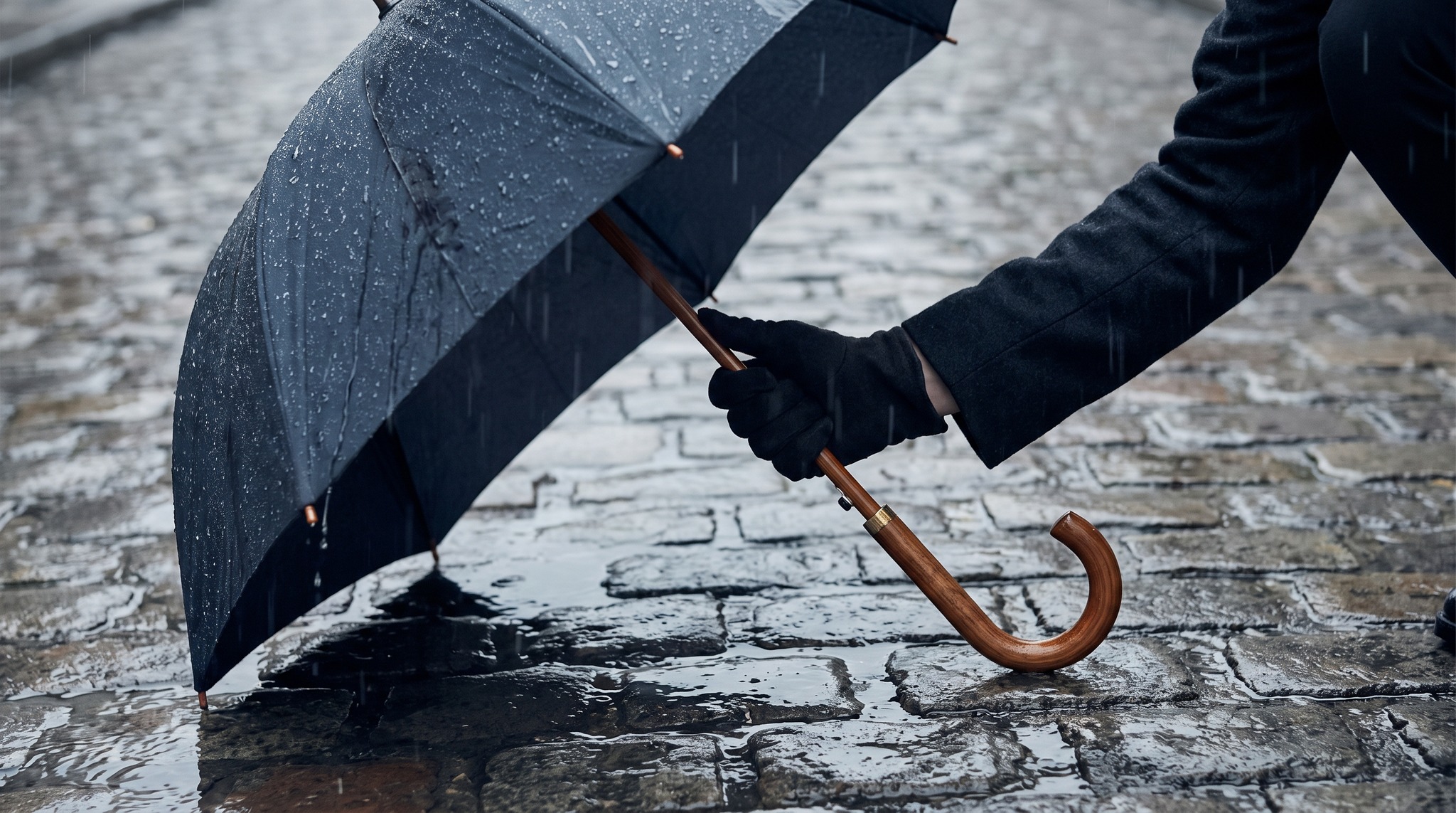
The shape of the handle determines how your hand grips the umbrella and where the weight rests. A straight knob handle sits in the closed fist, the weight presses on the fingertips. A crook handle distributes the load across the entire palm and relieves the fingers. With a wooden handle with a slight curve, the shape adapts to the natural curvature of the hand. The better the fit, the less force you need to exert to hold the umbrella, and the more relaxed the wrist remains over longer distances.
Balance: Where the Centre of Gravity Lies
An umbrella is balanced when the centre of gravity is close to the handle. With a walking umbrella with a wooden frame and heavy handle, the centre of gravity sits lower than with a light aluminium model with a plastic knob. If the centre of gravity is too high, the umbrella tips forward and you have to constantly counteract. A low centre of gravity makes the umbrella top-heavy, it pulls downwards. High-quality Men's umbrellas often use a solid wooden handle that balances the frame and keeps the umbrella steady in the hand.
Wrist and Walking Movement
When walking, the arm swings naturally, the wrist moves slightly back and forth. A rigid handle forces the wrist into a fixed position, which leads to tension. A crook handle allows a relaxed posture, the hand can rotate minimally without the umbrella slipping. A knob handle requires a firmer grip, but you have more control in gusts of wind. The choice depends on how you carry the umbrella: loosely on an outstretched arm or close to the body.
Material and Surface: Grip Without Pressure
The surface of the handle determines how securely you can grip without cramping. Smooth plastic handles slip when wet, you have to grip more firmly. Wood with matt lacquer or untreated finish offers natural grip. Leather or synthetic leather adapts to the shape of the hand and remains grippy even in rain. Pay attention to the thickness: a diameter of 25 to 30 millimetres suits most hands, thinner handles require more effort, thicker ones sit less securely in the palm.
Practical Notes for Everyday Use
When comparing Umbrellas, test the handle by holding it for a minute while taking a few steps. Do you feel pressure points on your fingers or palm? Does the umbrella tilt to the side when you relax your hand? A good handle no longer feels noticeable after a short time, you forget about it. That is the sign that form, balance and material work together.
- Crook handle: weight on the palm, relaxed posture, good for longer distances
- Knob handle: control in wind, requires firmer grip, compact posture
- Wood: natural grip, heavier, balancing effect on the balance
- Diameter 25 to 30 millimetres: suitable for most hand sizes
Related items: Jewellery, Bags and accessories, Pocket umbrellas. The complete range: Umbrellas.
Related categories: Jewellery, Bags and accessories, Pocket umbrellas. The full range: Umbrellas.
Read more: Steel or Fibreglass Frame: What Withstands Storms, Umbrella for Two People: Which Size Is Sufficient, Pagoda Umbrellas: The Most Striking Shape an Umbrella Can Have, Two Umbrellas in the Household: the Large and the Small, Short Distances, Full Pockets: The Folding Umbrella in Everyday Life