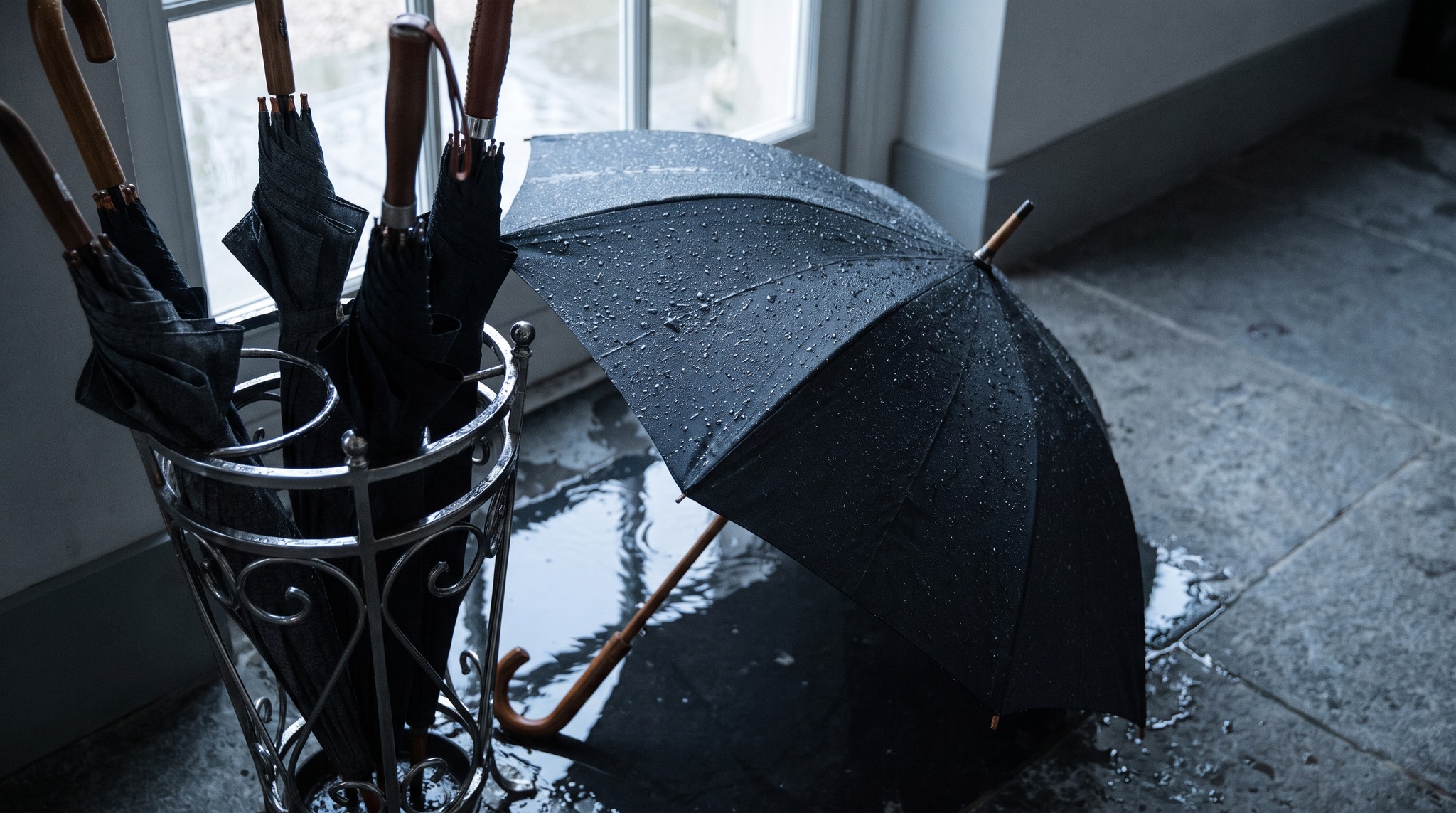
The Umbrella in the Stand: What Moisture Does to Floors
You come home soaking wet, place your dripping umbrella in the stand and think nothing more of it. Yet the runoff rainwater can leave clear marks on parquet, laminate or tiles. Water stains, swollen edges or discolouration often develop unnoticed when a puddle forms beneath the stand. Anyone wishing to protect their floor should know which materials react particularly sensitively and how damage can be avoided.
Why Wooden Floors Are Particularly at Risk
Parquet and laminate tolerate standing water poorly. After just a few hours, moisture can penetrate the joints and cause the backing boards to swell. With solid wood parquet, repeated wetness leads to discolouration that cannot be completely removed even by re-oiling. Sealed surfaces do offer a certain degree of protection, but the material remains vulnerable at the edges and transitions. An umbrella stand without a drip tray thus becomes a source of danger for high-quality floors.
Stone Floors and Tiles: Seemingly Robust, but Not Immune
Tiles and natural stone are considered resistant, yet rainwater leaves traces here too. Limescale deposits form particularly on dark tiles and polished granite. With natural stone such as marble or slate, acidic rainwater can etch the surface and create dull spots. The grouting between tiles absorbs moisture and discolours grey or brownish over time. Anyone regularly placing Umbrellas in the entrance area should therefore pay attention to a suitable base even with hard floors.
The Right Drip Solution for Every Umbrella Type
An umbrella stand with an integrated drip tray reliably catches the dripping water. The tray should be at least 3 to 4 centimetres high and have a capacity of approximately half a litre. For Men's umbrellas with a large span, a stand with a wider diameter is recommended so that the outer areas of the canopy also hang over the tray. Alternatively, a waterproof mat made of rubber or plastic protects the floor when no stand with a tray is available.
Materials in Comparison: Frame and Canopy
The amount of dripping water depends greatly on the material of the canopy. Polyester fabric stores hardly any moisture and dries quickly, whilst cotton-blend fabric absorbs more water and drips for longer. The frame also plays a role: steel ribs with many joints retain water droplets in the connections, whereas fibreglass ribs allow the moisture to run off rapidly. An umbrella with eight ribs and a span of 100 centimetres can bring up to 200 millilitres of water into the house after heavy rain.
Practical Care After Use
Open the umbrella fully upon your return and allow it to dry in a well-ventilated location, ideally on the balcony or in the shower. Only when the canopy and frame are completely dry should you fold the umbrella and store it away. This simple measure not only protects your floor but also considerably extends the lifespan of the umbrella. Mould formation on the canopy and rust on the frame can thus be effectively prevented.
Related items: Jewellery, Bags and accessories, Pocket umbrellas. The complete range: Umbrellas.
Related categories: Jewellery, Bags and accessories, Pocket umbrellas. The full range: Umbrellas.
Read more: Umbrellas at Garden Parties: Rain, Lawn and Rows of Chairs, The Umbrella When Hiking: Backpack Carriers, Handle and Weight, Handles Made of Wood, Horn and Acrylic: Materials for Umbrellas, The Wedding Umbrella: When It Rains on the Big Day, Umbrellas at Outdoor Concerts: Seating, Neighbours, Visibility